Case Study: Post-Migration Recovery & Stabilization
Client: The Arena Group
Industry: Content-driven entertainment / lifestyle property
CMS: WordPress (post-migration)
Primary acquisition channels: Google Search, Google News, Google Discover
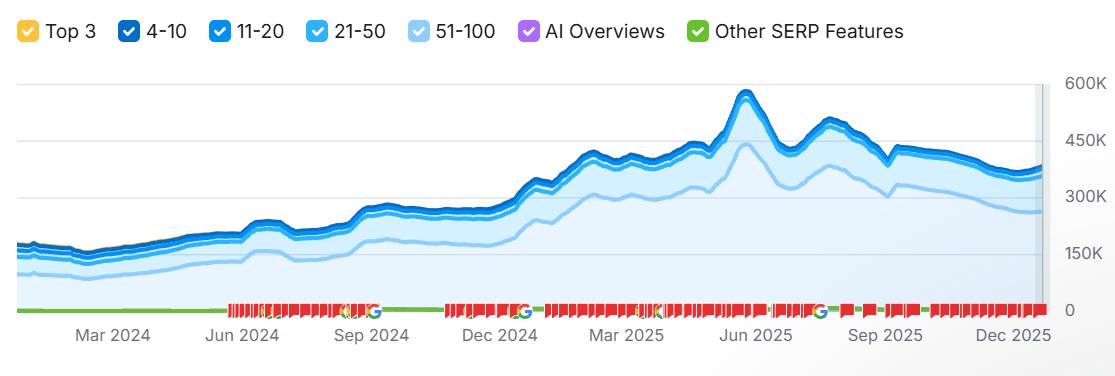
Restoring visibility and crawl integrity after a large-scale migration failure
Overview
Following a CMS migration to WordPress, ParadePets.com, part of The Arena Group, experienced significant organic search volatility and visibility loss. Despite strong editorial content and brand authority, the platform suffered from widespread indexation conflicts, crawl inefficiencies, and degraded eligibility across Google Search, News, and Discover.
I was engaged to diagnose root causes, stabilize performance, and re-establish durable technical and governance foundations to restore discoverability and long-term platform health.
Key Challenges Identified
The audit revealed systemic post-migration failures, not content quality issues:
- Conflicting indexation signals
Thousands of URLs marked noindex while simultaneously included in XML sitemaps - Broken migration mappings
~4.9K legacy URLs returning 404s without redirect coverage, causing equity loss - Sitemap integrity breakdown
170+ legacy and invalid sitemaps still referenced, including pre-launch files - Crawl budget waste
Excessive paginated URLs indexed; parameters incorrectly blocked via robots.txt - Author & E-E-A-T degradation
Broken author pages, duplicated bios, missing credentials, and poor internal linking - Performance regression
Core Web Vitals failures on mobile, impacting Discover and News eligibility
These issues compounded, leading to reduced crawl efficiency, ranking instability, and declining engagement.
Recovery Strategy
The remediation plan prioritized stabilization before optimization, with clear sequencing:
1. Indexation & Crawl Signal Repair
- Rebuilt XML sitemap logic to include only canonical, indexable, 200-status URLs
- Removed noindexed, redirected, and error URLs from all sitemap files
- Eliminated legacy sitemap references to stop crawl dilution
2. Redirect & Canonical Remediation
- Mapped and prepared 301 redirects for thousands of orphaned legacy URLs
- Standardized canonical behavior across articles, tags, pagination, and authors
- Canonicalized paginated URLs to their primary category counterparts
3. Robots.txt Rationalization
- Removed outdated disallow rules blocking crawl without preventing indexation
- Shifted index control to canonical and meta robots for predictable behavior
4. Author & Authority Infrastructure Fixes
- Repaired broken author templates and paginated profile canonicals
- Defined standards for bios, credentials, and outbound authority signals
- Reduced cross-domain author duplication to protect trust and attribution
5. Performance & Discover Readiness
- Identified Core Web Vitals regressions affecting mobile discovery
- Prioritized fixes across images, scripts, caching, and third-party load
Results & Impact
This engagement focused on recovery and stabilization, delivering measurable structural improvements:
- Restored crawl efficiency by eliminating conflicting sitemap and robots signals
- Reclaimed lost link equity through structured redirect recovery
- Improved indexation accuracy across articles, tags, and author pages
- Stabilized eligibility for Google News and Discover surfaces
- Established go-forward governance rules to prevent future post-migration failures
Most importantly, the platform moved from reactive remediation to a controlled, auditable technical foundation capable of supporting ongoing editorial growth.
Key Takeaway
Large-scale migrations fail not because of content—but because governance, indexation logic, and crawl signals are not rebuilt alongside the platform.
This case demonstrates that post-migration recovery is about restoring search engine trust through disciplined architecture, sequencing, and governance—not tactical fixes alone.