Case Study:
Enterprise Platform Transformation
Client: Audacy, Inc. One of the largest radio broadcasting companies in the U.S., operating hundreds of news, sports, music, and entertainment brands across 47 media markets.
Industry: Media & Broadcasting (Editorial, Audio, Sports, Entertainment)
Migration, Replatforming & Taxonomy Governance at Scale
Overview
This case study demonstrates how a large, fragmented media ecosystem was transformed into a unified, scalable digital platform. Through a coordinated migration, replatforming, and taxonomy governance initiative, a 100M+ URL property was consolidated into a single, structured ecosystem—improving crawl efficiency, content discoverability, editorial workflows, and platform scalability.
The initiative established standardized architecture, governance, and publishing foundations that improved operational consistency and strengthened visibility across search and news distribution platforms.
The Challenge
Audacy’s digital presence had evolved organically over time into hundreds of independent domains and subdomains. While this supported local brand autonomy, it created structural, operational, and discovery challenges at enterprise scale:
- Fragmented Architecture: Hundreds of disconnected properties across multiple CMS platforms limited scalability, consistency, and operational efficiency.
- Crawl & Indexation Inefficiency: Distributed URL structures diluted crawl budget and slowed indexation of high-value editorial content.
- Duplicate & Syndicated Content: Shared content across stations introduced canonical conflicts and ranking dilution.
- Inconsistent Taxonomy & Navigation: Disconnected tagging, navigation, and categorization reduced content discoverability for users and search engines.
- Uneven Structured Data Adoption: Inconsistent schema implementation limited eligibility for rich results and publisher visibility across news platforms.
The organization needed a scalable solution that balanced enterprise governance with editorial flexibility—without disrupting live publishing across hundreds of active brands.
The Approach
A phased platform transformation was executed, integrating migration strategy, information architecture, and governance into a unified enterprise framework.
1. Platform Consolidation & Architecture
- Unified hundreds of domains into a single, directory-based domain structure
- Designed scalable information architecture supporting local, regional, and national content
- Improved internal linking and navigational clarity across the ecosystem
2. Crawl & Indexation Optimization
- Refined robots.txt and XML sitemap strategies to prioritize high-value content
- Reduced index bloat from ~20M low-quality URLs to ~6M high-value pages
- Improved crawl efficiency and stabilized indexation across the platform
3. Taxonomy & Content Governance
- Designed a centralized taxonomy model for navigation, categorization, and tagging
- Standardized metadata and tagging conventions across all properties
- Improved content organization while preserving editorial autonomy
4. CMS & Template Standardization
- Consolidated multiple CMS platforms into a single enterprise CMS
- Simplified publishing workflows and reduced operational overhead
- Implemented scalable templates aligned to taxonomy and content structure
5. Structured Data & Publisher Visibility
- Implemented schema standards including NewsArticle, PodcastEpisode, Author, Organization, and Breadcrumb
- Strengthened eligibility for rich results, Top Stories, and news aggregation
- Improved publisher trust and content visibility across search platforms
Results & Impact
1. Platform & Operations
- Unified hundreds of properties into a single governed platform
- Reduced CMS complexity and engineering maintenance overhead
- Streamlined editorial workflows across hundreds of active contributors
2. Discovery & SEO Performance
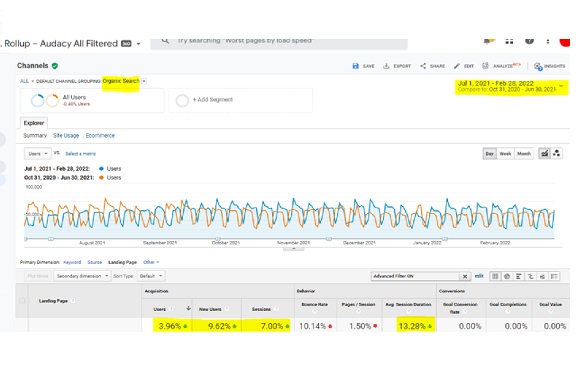
- Delivered +7% organic traffic growth post-migration
- Improved crawl efficiency by reducing low-value URLs at scale
- Resolved duplication and canonical conflicts across syndicated content
3. User Experience & Engagement
- Strengthened navigation clarity and content discoverability
- Increased engagement through improved contextual linking and categorization
4. Publisher & Platform Visibility
- Achieved consistent inclusion across Google News and Apple News for individual brands
- Expanded eligibility for rich results and enhanced SERP features
- Strengthened publisher trust and author transparency signals
Why This Matters
This transformation established a scalable publishing foundation for a complex media ecosystem. By aligning migration, taxonomy, governance, and technical SEO into a unified platform strategy, the organization improved operational consistency, content discoverability, and long-term search visibility—without disrupting editorial operations across hundreds of active brands.