Case Study: Enterprise SEO, AEO/GEO & AI Discoverability
Client: STEM Fellowship
Industry: Nonprofit / Education
Scale: National Program
Scope: Content Re-architecture, Intent Pathways, SEO/AEO/GEO & AI Discoverability
Overview
The High School Big Data Challenge previously relied on a single program page to serve multiple audiences, pathways, and information needs. As the program expanded, that structure made it harder to align content with distinct search intent, clearly differentiate participation options, and create focused entry points for both traditional search and generative AI discovery.
I led the re-architecture of the 2026–27 program experience into a three-page, intent-driven structure: a central program landing page supported by dedicated pathway pages for Scholar Internship and Independent Research. The work established clearer content relationships, stronger answer readiness, and a more scalable discoverability framework designed to support independent organic and AI visibility across each stage of the user journey.
The Challenge
The High School Big Data Challenge relied on a single program page to serve multiple audiences, participation pathways, and decision points. As the program evolved, the page had to communicate increasingly distinct experiences within one content structure, making it harder to align information with user intent and create focused entry points for search and AI discovery.
Key challenges included:
- Multiple intents on a single page: Students, educators, and prospective participants with different goals were directed into the same experience, reducing clarity around which pathway best matched their needs.
- Limited pathway discoverability: Scholar Internship and Independent Research did not have dedicated search entry points, restricting their ability to surface independently for pathway-specific and non-branded queries.
- Weak intent-to-content alignment: Different eligibility requirements, formats, fees, learning models, and participation expectations competed for attention within one page.
- Constrained organic search footprint: A single URL limited the program’s ability to capture a broader range of search demand across distinct topics and user journeys.
- Limited answer readiness: Broad, multi-purpose content made it harder to structure clear answers around specific questions, program entities, and pathway differences for both search engines and generative AI systems.
- Scalability limitations: Adding new program details or pathways would have increased the complexity of an already overloaded page and made the experience harder to maintain.
The challenge was therefore broader than optimizing individual page elements. The program required a new information architecture that could separate distinct user intents, create independent discovery surfaces, clarify pathway relationships, and establish a more scalable foundation for organic search, answer engines, and AI-driven discovery.
The Approach
The strategy focused on transforming HSBDC from a single, multi-intent program page into a clearer, intent-driven content architecture designed to improve discoverability, answer readiness, and scalability across traditional search and generative AI experiences.
1. Intent & Information Architecture Redesign
- Mapped distinct audience needs, decision points, and search intents across the HSBDC experience
- Reorganized the program from one broad page into a three-page architecture: a central HSBDC landing page supported by dedicated Scholar Internship and Independent Research pathway pages
- Created clearer relationships between the overall program and each participation pathway
- Reduced information overload by moving pathway-specific details into focused, purpose-built experiences
2. Content & Answer Architecture
- Rebuilt program content around the questions prospective participants needed answered before registering
- Developed clear, structured content covering eligibility, fees, participation format, deadlines, program expectations, individual versus team participation, and pathway differences
- Organized information into more concise, answer-ready sections that could be understood independently as well as within the broader program journey
- Improved consistency across program, pathway, registration, and supporting content
3. SEO, AEO/GEO & AI Discoverability
- Aligned page structure, headings, terminology, and content hierarchy with distinct search intent
- Expanded the program’s organic search footprint by creating dedicated entry points for pathway-specific and non-branded discovery
- Strengthened semantic relationships between the HSBDC program, its pathways, requirements, costs, timelines, and participation options
- Structured content to improve answer extraction and contextual understanding across search engines and generative AI experiences
4. Measurement, Validation & Iteration
- Established a measurement framework across Google Search Console, GA4, and generative-AI visibility reporting
- Monitored page-level clicks, impressions, rankings, organic landing sessions, engagement, and AI visibility across all three pages
- Evaluated query expansion to understand how the new architecture was capturing broader and more specific search intent
- Used performance data to validate the three-page model and establish a scalable framework for future HSBDC program cycles
Results & Impact
The new HSBDC architecture significantly expanded the program’s search footprint and created independent discovery pathways across traditional search and generative AI during the 2026–27 registration cycle.
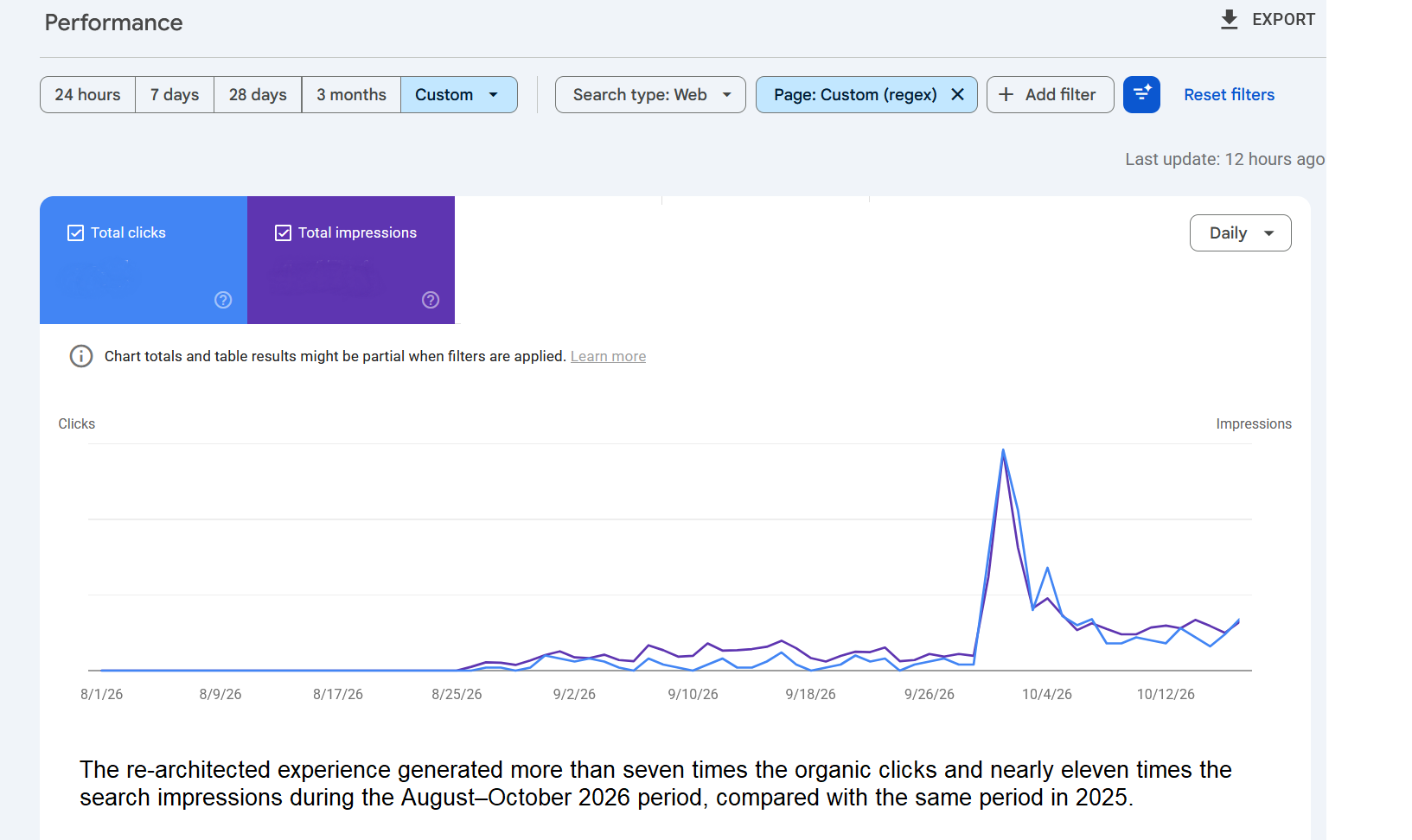
- Generated more than 7× the organic clicks and nearly 11× the combined search impressions during the August–October 2026 period, compared with the same period in 2025.
- Nearly tripled organic clicks on the primary HSBDC landing page alone, while increasing its search impressions almost sevenfold
- Established Scholar Internship and Independent Research as independent organic entry points, rather than relying exclusively on the main program page for discovery
- Expanded visibility across broader, pathway-specific, and question-based search intent, including queries related to eligibility, cost, participation format, registration, and program options
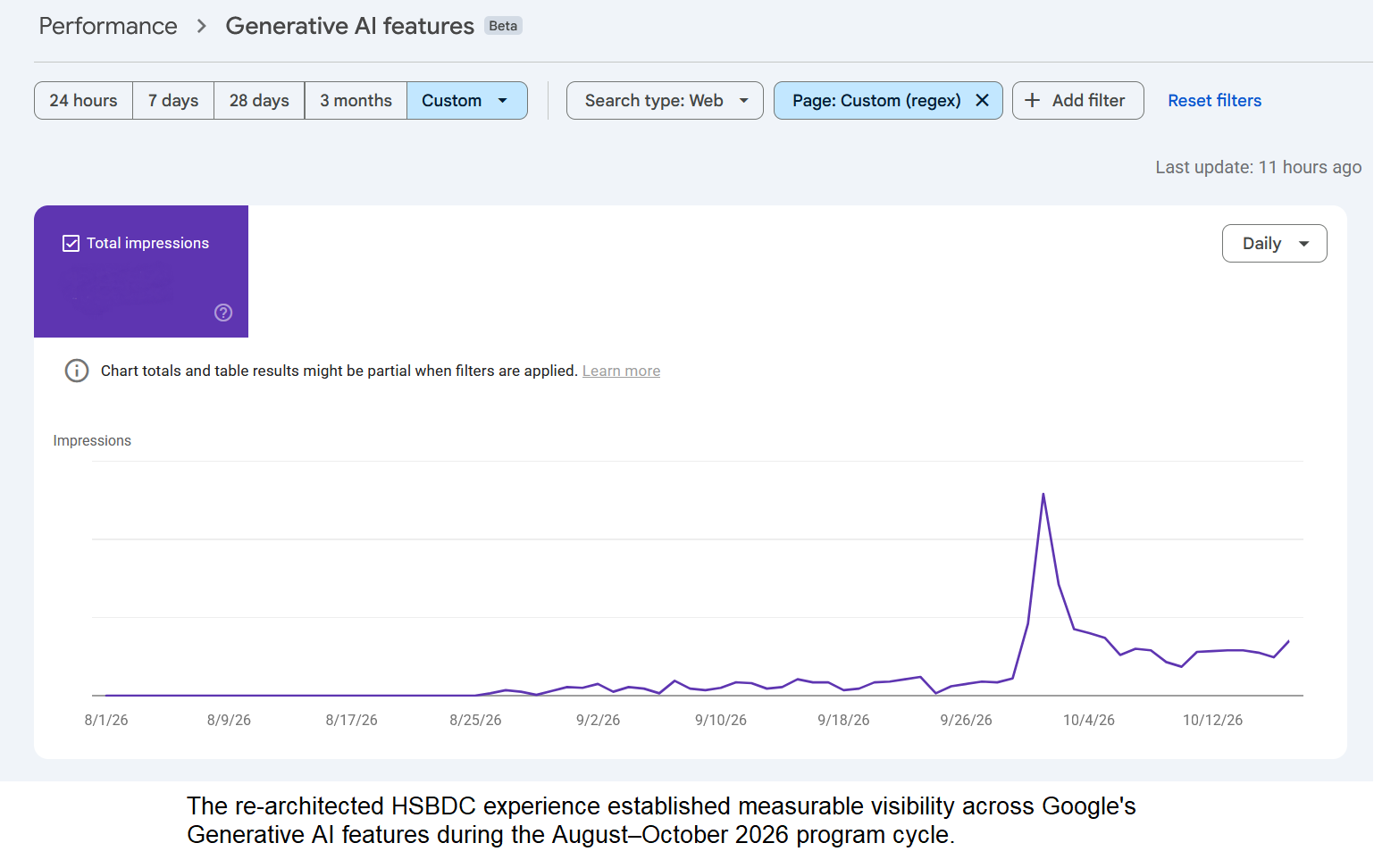
- Generated measurable generative-AI visibility across all three pages, demonstrating that the new content architecture was discoverable beyond traditional search results
- Improved content engagement across the dedicated pathway experiences, supporting the value of separating distinct audience needs into more focused pages
- Created a repeatable measurement framework across Google Search Console, GA4, and generative-AI reporting to evaluate search visibility, engagement, and emerging AI discovery
Most importantly, HSBDC evolved from a single multi-purpose page into a broader search and AI discovery ecosystem. The new architecture expanded the program’s addressable search footprint while giving each participation pathway its own discoverable, answer-ready destination—creating a more scalable foundation for future program cycles.
Key Takeaway
Search and AI discoverability require more than optimizing individual pages. By restructuring HSBDC around distinct user intent, creating dedicated pathway entry points, and organizing content for clearer answers and stronger semantic relationships, the program expanded its organic search footprint and established measurable visibility across both traditional and generative AI discovery. The result was a more scalable content architecture capable of supporting future program cycles, evolving search behavior, and increasingly AI-driven discovery.