Case Study: AI / AEO / GEO Readiness
Structured Content & Entity Modeling for AI Discovery
Client: Barrett Media
Industry: Media / Industry Analysis
Content Type: Breaking news and high-velocity editorial coverage
Discovery Surfaces: Google Search, Google AI Overviews, Perplexity, Bing / Copilot
The content operated in a high E-E-A-T-sensitive environment where authority, accuracy, and structured clarity influenced visibility across search and emerging AI-driven discovery surfaces.
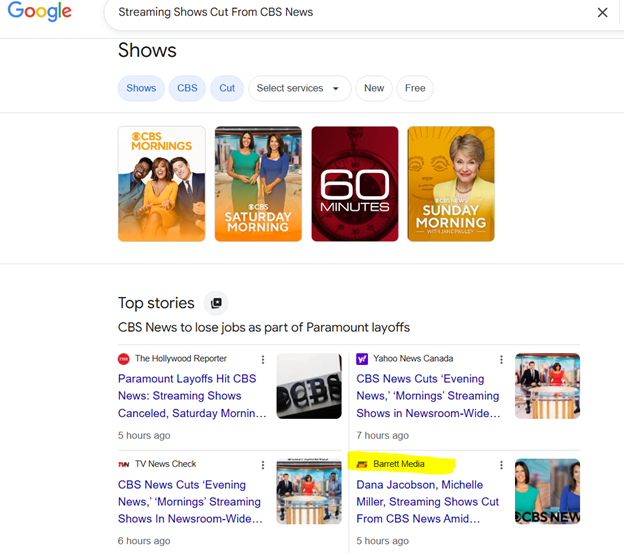

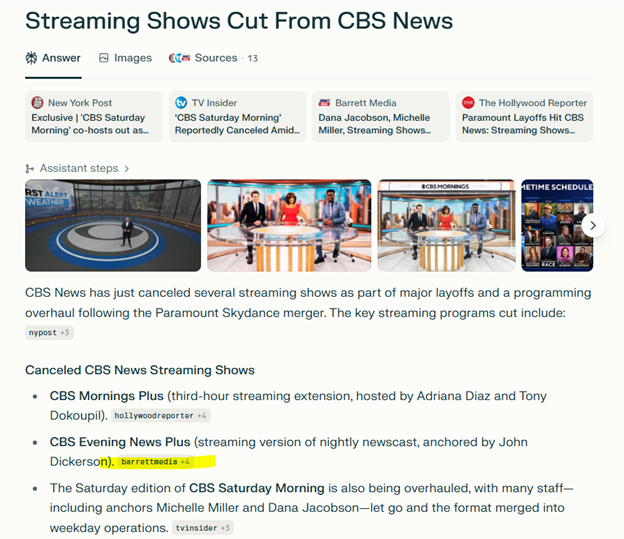
Structured Content & Entity Modeling for AI-Driven Discovery
How Structured Content Wins Visibility in AI & Answer Engines
Challenge
Traditional SEO optimization alone was insufficient for emerging AI-driven discovery patterns. Key challenges included:
- Increased emphasis on clear, concise, extractable answers
- Growing competition for citation eligibility, not just rankings
- Limited governance around entity usage, content structure, and answer formatting
- No direct reporting for AI visibility, requiring proxy-based validation
The goal was to strengthen the content structure, authority signals, and semantic clarity needed to improve eligibility across AI-driven discovery surfaces.
Strategy
The approach treated AEO as a content governance and information architecture initiative focused on improving structural clarity, entity consistency, and discoverability across emerging AI-driven search experiences.
Core Principles
- Improve structural clarity and answer visibility
- Strengthen entity consistency and semantic relationships
- Prioritize authority signals and semantic clarity
- Standardize editorial formatting to support discoverability across search and AI-driven surfaces
Implementation
1. Content Modeling & Search Intent Alignment
- Structured headlines and H1s to align with conversational search intent
- Ensured titles functioned as clear, answer-oriented statements
- Reduced ambiguity through more consistent content framing
2. Answer-First Content Architecture
- Delivered the primary answer within the first 100 words
- Prioritized factual clarity and concise summaries near the top of the page
- Reduced narrative delay common in traditional editorial formats
3. Entity & Semantic Optimization
- Implemented accurate, consistent entity usage across people, organizations, and topics
- Strengthened relationships between entities to support semantic clarity
- Standardized entity usage across headings, body content, and metadata
4. Authority & Trust Signaling (E-E-A-T)
- Standardized author attribution and publisher identity
- Improved structural consistency across templates
- Aligned technical foundations including Core Web Vitals, structured markup, and internal linking to reinforce credibility
Measurement & Validation
Because AI-driven discovery surfaces currently provide limited direct attribution reporting, impact was evaluated through search visibility trends, engagement signals, and proxy-based validation.
1. Primary Validation (Google Search Console)
- Significant impression growth during the news cycle
- Strong CTR stability within high-velocity SERP environments
- Increased branded query visibility during peak demand periods
- Sustained page-level visibility across priority search experiences
2. Secondary Validation (Analytics)
- Conversion of search visibility into qualified referral traffic
- Engagement metrics aligned with high-intent content consumption patterns
These combined signals indicated increased discoverability and authoritative visibility across search and emerging AI-driven discovery surfaces.
Results
- Achieved strong visibility during a critical breaking-news cycle
- Converted search visibility into measurable referral traffic
- Increased branded search interest during peak visibility periods
- Demonstrated repeatable governance and content structuring patterns supporting AI-driven discoverability
Key Takeaway
Visibility across AI-driven discovery surfaces depends on more than traditional ranking signals. Structured content, entity consistency, authority signals, and editorial governance increasingly influence how content is interpreted, summarized, and surfaced across modern search experiences.
This case study demonstrates how scalable content architecture and governance can improve discoverability across evolving search and AI-driven environments without relying on speculative optimization tactics.