Case Study: From Prompt to Citation
AI / AEO / GEO Readiness
Client: Barrett Media
Industry: Media / Industry Analysis
Content Type: Breaking news and high-velocity editorial coverage
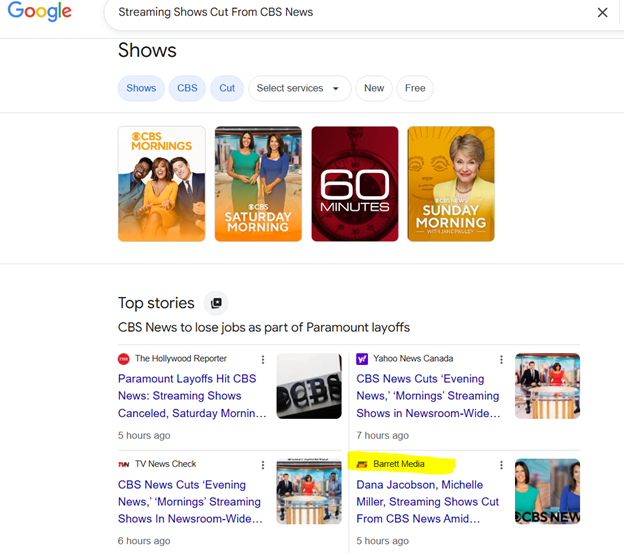
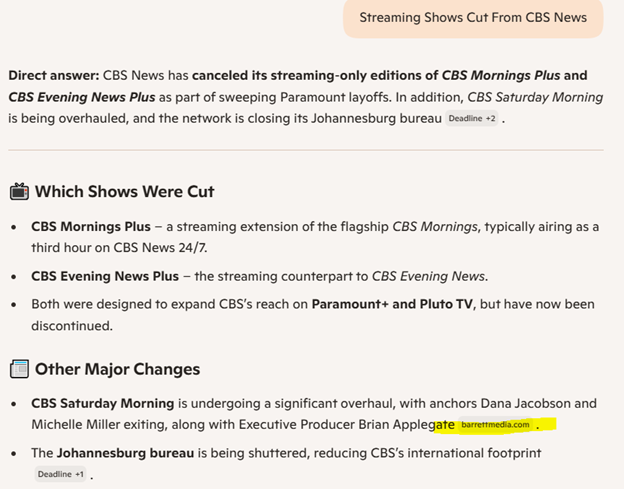
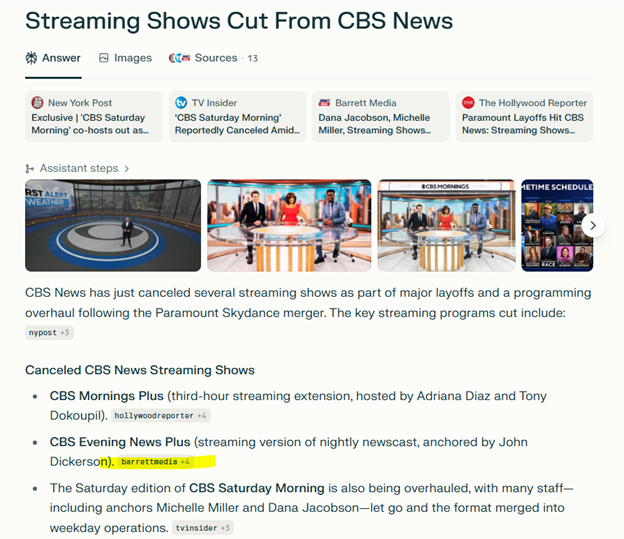
Discovery Surfaces: Google Search, Google AI Overviews, Perplexity, Bing / Copilot
The content operated in a high E-E-A-T-sensitive environment, where accuracy, authority, and clarity directly influence whether AI systems trust and surface a source.
Structured Content & Entity Modeling for AI-Mediated Discovery
How Structured Content Wins Visibility in AI & Answer Engines
Challenge
Traditional SEO optimization was insufficient for emerging discovery patterns. Key challenges included:
- AI systems prioritizing clear, concise answers over long-form narrative
- Increased competition for citation eligibility, not just rankings
- Lack of governance around entity usage, content structure, and answer formatting
- No direct reporting for AI visibility, requiring proxy-based validation
The goal was to ensure content was structurally preferred by AI systems, not merely indexed.
Strategy
The approach treated AEO as a content governance and information architecture problem, not a publishing tactic.
Core Principles
- Optimize for extraction, not just consumption
- Align content structure with LLM parsing behavior
- Prioritize authority signaling and semantic clarity
Implementation
1. Content Modeling & Prompt Alignment
- Structured the H1 and headline to directly match conversational search intent
- Ensured titles functioned as complete, answerable statements
- Reduced ambiguity to increase extraction efficiency
2. Answer-First Content Architecture
- Delivered the primary answer within the first 100 words
- Front-loaded factual clarity to align with AI summarization behavior
- Eliminated narrative delay common in traditional editorial formats
3. Entity-Driven Optimization (GEO Signal)
- Implemented dense, accurate entity usage (people, organizations, transactions)
- Reinforced relationships between entities to support semantic confidence
- Ensured consistency across headings, body content, and metadata
4. Authority & Trust Signaling (E-E-A-T)
- Standardized author attribution and publisher identity
- Ensured structural consistency across templates
- Aligned technical foundations (CWV, markup, internal linking) to reinforce credibility
Measurement & Validation
Because AI discovery surfaces do not yet provide direct attribution reporting, impact was validated through search-side proxy signals and behavioral confirmation.
1. Primary Validation (Google Search Console)
- Significant impression lift during the news cycle
- Strong CTR stability despite high-velocity SERP environments
- Noticeable branded query lift, indicating authoritative visibility
- Page-level dominance during peak demand windows
2. Secondary Validation (Analytics)
- Conversion of visibility into high-quality referral traffic
- Engagement metrics consistent with authoritative consumption patterns
- These combined signals confirmed eligibility and selection behavior, not just ranking performance.
Results
- Achieved dominant visibility during a critical breaking-news window
- Converted search authority into measurable referral traffic
- Triggered branded demand following AI-mediated exposure
- Demonstrated repeatable patterns for AI-ready editorial governance
Key Takeaway
AI discovery is not a ranking problem—it is a governance problem.
Organizations that want to win visibility across AI Overviews, answer engines, and LLM-powered interfaces must design content systems that prioritize:
- Structural clarity
- Entity precision
- Authority signaling
- Answer-first architecture
This case study shows how product-level content governance enables durable discovery in an AI-mediated search landscape—without relying on speculative tactics or opaque tooling.